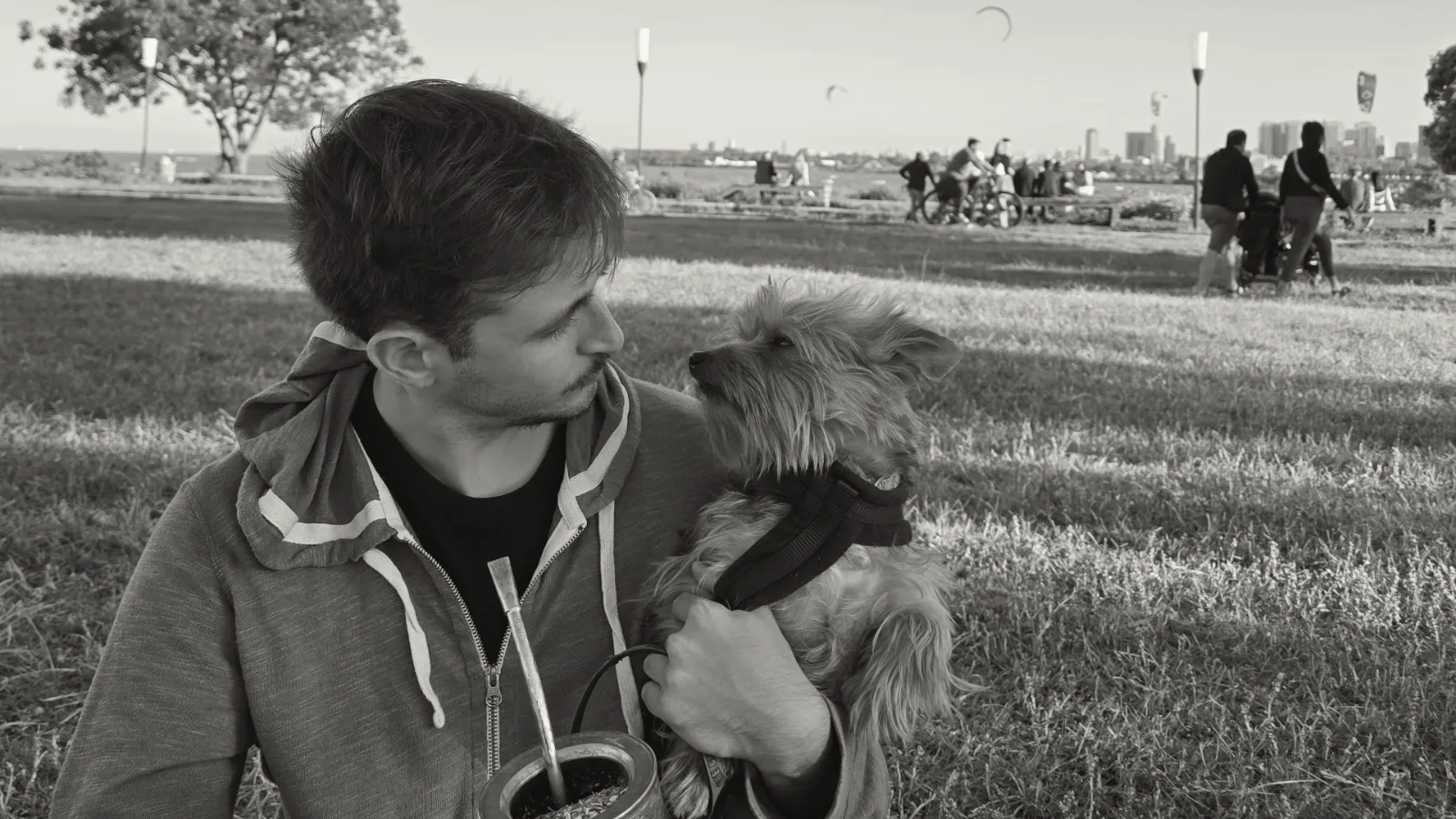
Oliver loves me, but he doesn't know what that is
Does Oliver understand what I say to him?
It's been proven that dogs understand more than 200 words, have imagination, and can assume we have intentions. They're capable of evoking things that are absent.
For example, the University of Zurich ran an experiment in which dogs had to guide humans towards one of three boxes: one with a sausage, another with a biscuit, and a third one empty. Sometimes the human was "cooperative" and gave them the food they found; other times they were "competitive" and kept it for themselves. When the dogs realised the competitive human kept the reward, they guided them towards the empty box more often, saving the location of the sausage for interactions with the cooperative human. This would suggest that dogs brains, like ours, "simulate" realities that aren't present. In other words, they can model the world: imagining two parallel scenarios in which different hypothetical actions lead to different outcomes.
So, does Oliver understand when I talk to him? To how far?
It seems we can't get too far by talking to them. According to the philosopher Ludwig Wittgenstein, complex imagination is anchored in the grammar of language. For example, take the prospection.
Oliver can "imagine" my return home because there are present cues (my voice when I'm on a video call with my family, at which point he goes and stares straight at the front door), but he can't imagine an abstract concept like "he'll be back for Christmas", because he lacks the linguistic structure to sustain that thought.
I think it like this: dogs and humans look at the same space with our minds, but at different resolutions. Where dogs can only make out a blurry smudge called the future, we can pick out the details that mean tomorrow, in a while, next year.
So to put it differently: Oliver knows that I love him, but he probably couldn't explain what love is.
x
Source of thought: Cosas que mi gato tendría que saber, EGYLC